
Green vs red vs violet laser pointer: which colour should you buy?
Green, red or violet? How the three laser colours differ in brightness, range and use, and which one suits your plans.
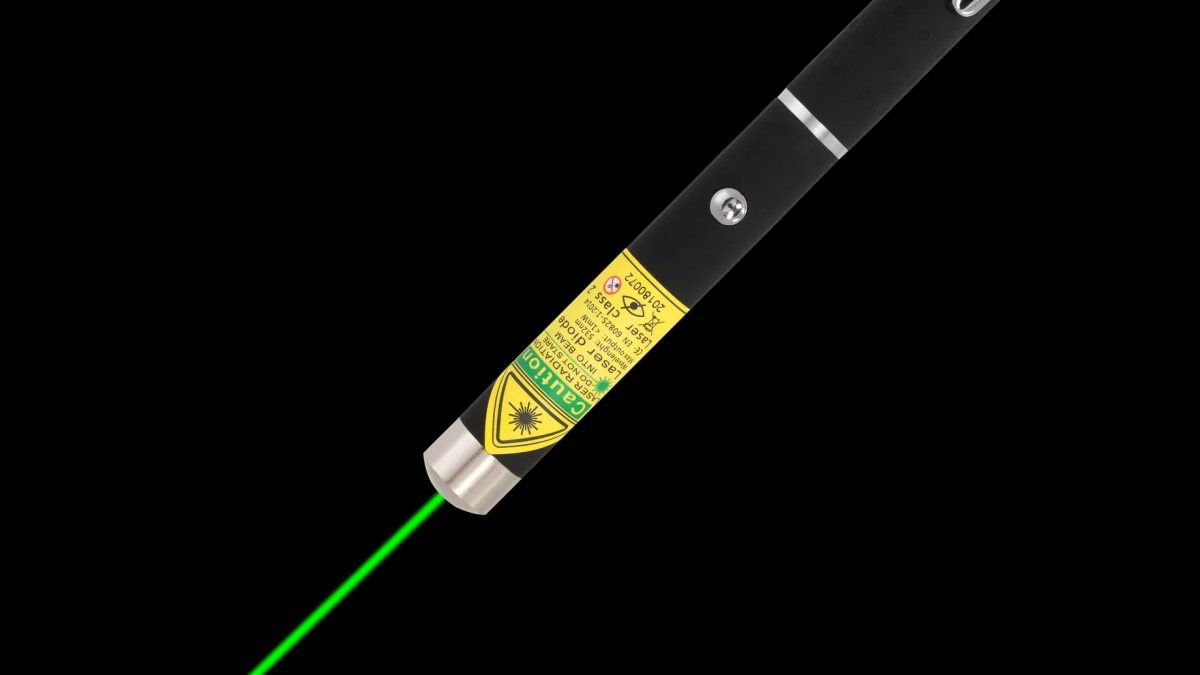
The colour of a laser pointer is not a matter of taste alone. It determines how bright the dot looks, how far you can see it, whether you can see the beam at night, and which tasks the laser is good at. This guide compares green, red and violet laser pointers in class 2 and ends with a straightforward recommendation.
How the eye sees laser colours
All three colours in our range have the same class 2 output, at most 1 mW. Yet they look completely different in brightness. The reason is the human eye. In daylight our vision is most sensitive to green-yellow light around 555 nm. The further a colour lies from that peak, the dimmer it appears at the same output.
- Green, 532 nm: close to the peak. Looks very bright.
- Red, 650 nm: well down the curve. Looks clearly less bright.
- Violet, 405 nm: at the very edge of vision. Looks faint.
In practice a green dot looks several times brighter than a red one, and many times brighter than violet.
Green laser pointer: the all-rounder
Green is our best-selling colour for a reason. It gives the longest indicative range: about 100 m by day when the dot lands in shade, around 300 m at twilight and roughly 1 km in darkness. It is also the only class 2 colour whose beam you can faintly see in dark, humid air, which is why astronomers use it to point out stars.
Best for: stargazing, scaring birds at dusk and dawn, outdoor pointing, large lecture halls. Less ideal for: small dark rooms where a green dot can feel harsh.
Models: X1 pen, X2 pen with patterns, G3 Pro, G1 Pro and G2 Pro. See the green laser pointer category.
Red laser pointer: the classic for screens
Red is the traditional presentation colour, and it remains a very good one. The dot is clear on a projector screen without overpowering the slide, and many people find it calmer to look at. Its range is shorter: approx. 30–50 m in daylight, approx. 100–150 m at twilight and approx. 300–500 m in the dark.
Best for: lectures, meetings, training, calm cat play. Less ideal for: stars and long outdoor distances.
Models: M1 pen, R1 Pro and R2 Pro in the red laser pointer category.
Violet laser pointer: the special effect
Violet looks the dimmest, with an indicative range of approx. 10 m in daylight, 50 m at twilight and 200 m in darkness. Its strength lies elsewhere: 405 nm light makes many fluorescent and phosphorescent materials light up. Glow-in-the-dark paint stores the light and keeps shining, so you can literally draw with it. Highlighter ink, some minerals and certain fabrics fluoresce brightly.
Best for: science demonstrations, light painting, curiosity. Less ideal for: presentations and distance.
Models: Z1 pen, V1 Pro and V2 Pro in the violet laser pointer category.
Side-by-side comparison
| Green | Red | Violet | |
|---|---|---|---|
| Wavelength | 532 nm | 650 nm | 405 nm |
| Perceived brightness | Very high | Medium | Low |
| Dot in darkness | approx. 1 km | approx. 300–500 m | approx. 200 m |
| Beam visible at night | Faintly | Hardly | Hardly |
| Presentations | Large halls | Ideal | Not suitable |
| Stars and birds | Ideal | Limited | Not suitable |
| Glow effects | Limited | No | Ideal |
A note on "blue" and other colours
You may see people search for a blue, yellow or pink laser pointer. Our 405 nm violet is sometimes described as blue or purple. Other colours exist in the market but are rare in class 2 and offer no practical advantage over green for visibility.
Colour and the people around you
There is one more factor worth considering: how the colour feels to others. In a small, dim meeting room a green dot can look almost too bright and draw attention away from the slide. Red is gentler there. In a large hall the opposite applies: the back rows will thank you for green. Outdoors, green is simply more practical, and in a group of stargazers it is the only colour that lets everyone follow the beam. Violet tends to fascinate people at close range, which makes it a hit at science evenings and with children watching an adult demonstrate, but it is never the right colour for pointing at something far away.
Pens and Pro models in each colour
Each colour is available as a slim pen on AAA batteries and as rechargeable Pro models with a PowerFox charger. The green line is the largest, with two pens and three Pro models, including the G1 Pro with a removable pattern lens and the X2 pen with a pattern cap. Red and violet each have one pen, one full-size Pro with two safety keys and one compact Pro. That means you can choose colour first and format second, without compromise. Our rechargeable laser pointer page shows all Pro models together.
Which colour should you buy?
- You want one laser for everything: green, for example the G3 Pro.
- You mainly present in normal rooms: red, for example the M1.
- You love experiments and light art: violet, for example the Z1.
- You cannot decide: the laser pointer pen set gives you all three.
Whatever the colour, the safety rules are the same: never aim at eyes, people, animals, vehicles or aircraft. Read laser pointer eye safety and laser pointer safety, and see our laser pointer buying guide for the other choices.
More articles
Blog
Laser pointer buying guide for Ireland: how to pick the right one
Colour, shape, battery and safety: a clear, step-by-step guide to buying a laser pointer in Ireland without wa…
How far does a class 2 laser pointer reach – and how bright is it really?
Real-world distances for green, red and violet class 2 laser pointers by day, at dusk and in the dark, and why…
Rechargeable or AAA laser pointer? 18650 and 16340 cells versus AAA
Should your laser pointer run on AAA batteries or a rechargeable 18650 or 16340 cell? A practical comparison,…