
Laser classes explained: from class 1 to class 4, and why class 2 matters
What do laser classes 1, 2, 3R, 3B and 4 mean? A clear overview of the EN 60825-1 classification and what it means when you buy a laser pointer.
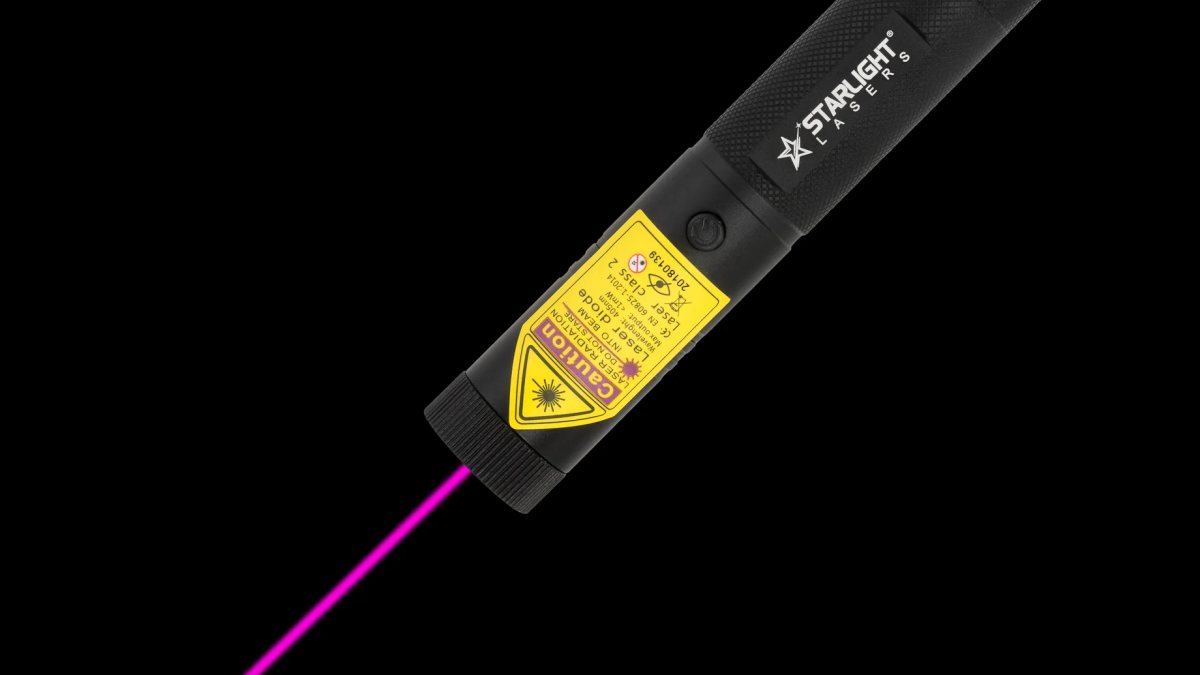
Every proper laser product carries a class. That class tells you more about safety than any marketing claim on the box. Yet few buyers know what the classes actually mean. This article explains the system used in Europe, EN 60825-1, from the harmless class 1 to the hazardous class 4, and what it means for you when you choose a laser pointer.
Why lasers are classified
Lasers vary enormously in output, from the tiny diode in a computer mouse to industrial lasers that cut steel. To make the risks clear, manufacturers classify each product according to how much accessible laser radiation it emits and how hazardous that is to eyes and skin. The class must be stated on the product label, together with a warning symbol for classes above 1.
The classes at a glance
| Class | In plain words | Typical examples |
|---|---|---|
| 1 | Safe under all normal conditions | CD players, laser printers |
| 1M | Safe unless viewed through optics | Some fibre-optic equipment |
| 2 | Visible, low output; blink reflex normally protects | Consumer laser pointers, barcode scanners |
| 2M | As class 2, unless viewed through optics | Some levelling devices |
| 3R | Higher risk; avoid direct eye exposure | Some alignment lasers |
| 3B | Direct beam hazardous to the eye | Research, show and industrial lasers |
| 4 | Hazardous to eyes and skin, fire risk | Cutting, medical and large show lasers |
Class 1 and 1M
Class 1 lasers are safe in normal use, often because the laser is fully enclosed. You own several without knowing: in printers, optical drives and many sensors. Class 1M is similar, but magnifying optics such as binoculars could make the beam hazardous.
Class 2: the consumer laser pointer class
Class 2 applies to visible lasers with an output of at most 1 mW. At that level, the natural aversion response – blinking or turning away – normally protects the eye during brief, accidental exposure. That is why class 2 is the class for laser pointers sold to consumers. It is still a laser: deliberately staring into it, or pointing it at someone's eyes, is unsafe. Class 2M follows the same idea but with a wider beam that becomes hazardous through optics.
All our lasers, from the X1 pen to the G3 Pro, are class 2 with max. 1 mW, tested before dispatch, and labelled accordingly.
Class 3R
Class 3R allows visible lasers up to 5 mW. The risk from a brief exposure is still considered low, but the safety margin of class 2 is gone. Direct eye exposure should be avoided. Many cheap online lasers labelled "5 mW" belong here, or are in practice much stronger than claimed.
Class 3B and class 4
Class 3B lasers can injure the eye before you blink, and even some reflections can be hazardous. Class 4 lasers can also burn skin and ignite materials. These are tools for laboratories, industry, medicine and professional light shows, used with protective eyewear and trained operators. They are not meant to be used as hand-held pointers by the public.
Why "more powerful" is not better
It is tempting to think a stronger laser is a better laser. For the jobs people actually do with a pointer – presenting, stargazing, moving birds on at dusk, playing with a cat – class 2 is enough. A green class 2 dot stays visible at roughly a kilometre in the dark. What a higher class adds is mainly risk: to your own eyes, to the people around you, and to pilots and drivers. See how far does a class 2 laser pointer reach for the real-world distances.
How to read a laser label
- Class: look for "Class 2" or "Laser 2".
- Output: should be stated, for class 2 at most 1 mW.
- Wavelength: e.g. 532 nm for green, 650 nm for red, 405 nm for violet.
- Standard: EN 60825-1 or IEC 60825-1.
- Warning symbol: the yellow triangle with a starburst.
Missing any of these? Do not buy. A label that says class 2 on a laser advertised as burning paper is a contradiction and a red flag.
Common misunderstandings
- "Class 2 is completely harmless." No: it relies on the blink reflex and sensible use.
- "A dimmer colour is safer." Not necessarily: violet looks faint, but the eye still receives the light.
- "Pro means stronger." In our range, Pro means build, battery and key lock; every model is class 2.
- "The mW number on the box is accurate." Not always with unlabelled lasers sold online; the real output can be far higher than stated.
Your responsibility as a user
We do not cite rules for every situation here, because what matters most is behaviour. The class tells you the hazard; how you use the laser determines the risk. Never aim at eyes, people, animals, vehicles or aircraft, keep lasers away from children and use safety keys where available. Our laser pointer eye safety article and the laser pointer safety page give practical guidance.
Where the class appears on our lasers
Every Starlight laser carries a laser class warning label on the housing, and the class, output and wavelength are listed on each product page in our specification tables. If you ever want to double-check a model before buying, the compare tool puts them side by side.
Summary
Laser classes run from 1 (safe) to 4 (hazardous). Class 2 is the consumer laser pointer class: visible light, at most 1 mW, protected by the blink reflex against brief accidental exposure. It is all you need for pointing, presenting and stargazing. Ready to choose? Start with our laser pointer buying guide or browse the green laser pointer range.
More articles
Blog
Laser pointer buying guide for Ireland: how to pick the right one
Colour, shape, battery and safety: a clear, step-by-step guide to buying a laser pointer in Ireland without wa…
How far does a class 2 laser pointer reach – and how bright is it really?
Real-world distances for green, red and violet class 2 laser pointers by day, at dusk and in the dark, and why…
Green vs red vs violet laser pointer: which colour should you buy?
Green, red or violet? How the three laser colours differ in brightness, range and use, and which one suits you…